
Why is it so hard to express my needs?Many people know what they need. Yet when it comes to expressing those needs, something gets in the way. Read the blog to learn more and what small steps you can take.

Arguments in relationships; A blog exploring repeating conflict cycles in relationships, including between parents and teenagers.
Do you find yourself in the same arguments, over and over?
Stuck in the same conflicts?
Perhaps you shut down when an argument becomes heated or you can hear your voice become louder and louder, just to be heard? Or perhaps you find yourself in a heated argument with your teenager about curfew time that started out of nowhere?

Arguments in relationships happen and these are normal. When the relationship is balanced, you will be able to reflect on these and be open to finding ways forward. However, when the relationship isn’t balanced or you haven’t found a way to communicate differences together, then you’ll likely find yourself on the drama triangle. More on this below.
Why you feel unheard
Feeling unheard in your relationship often arises because of poor communication, emotional disconnection or defensiveness. Teenagers will feel the need to become more independent, but are managing unfamiliar or intense emotions and are not sure how to handle these so they may withdraw or become reactive.
Poor communication can be caused by daily stress or being distracted. Hurt from the past or conflict that has been ongoing creates a wall between you which makes it harder to really hear what the other person is trying to say.
Relationship patterns
These miscommunication patterns or conflict patterns often stem from attachment styles and how we learnt to express our needs in our families of origin. When we find ourselves in conflict that may resemble how we felt in the past can heighten the experience in the moment, increasing our reactions.
Hidden cycles
When we fall back into old patterns in time of stress or conflict, we can find ourselves on the drama triangle. This is a social model that maps interaction that is dysfunctional in three parts: the victim, rescuer and the persecutor. It is a model designed to visualise and make clear which positions you might take, often switching between them to avoid personal responsibility or to feel in control.
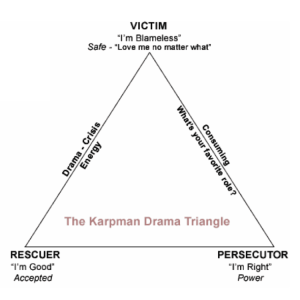
The victim feels helpless and hopeless. Often shuts down and waits for the rescuer to handle the problems for them. The rescuer often enabled the victim by helping them without asking. This is a way for the rescuer to feel needed. The persecutor criticises and blames others, so they feel in control. Their reaction is often out of defence.
When you find yourself in these positions, you may notice you also shift between them. To step out of the drama triangle, the aim is to consciously choose not to engage in the power game. Instead you can try to engage in a healthy, assertive communication. This involves setting boundaries and accepting your responsibility in the relationship and conflict.
It’s not just the argument
As you have learnt above, arguments in relationships are rarely about the argument themselves; you may have forgotten to take the washing out of the dryer (again), you might have done the grocery shopping, but forgot some items (again) or you might have allowed your child to have a mars bar while your partner told them no. As you may have noticed, these are seemingly small things to argue about.
The key is the pattern. The repetition of the same argument. Underneath lies the disconnection, feeling of being undervalued and unsupported.
- One person feels unheard → reacts
- The other feels challenged → responds defensively
- Both feel misunderstood → the conflict escalates
Over time, this can become a familiar cycle.
A gentle reflection:
When tensions rise, it can sometimes help to pause and ask:
What might my partner be feeling right now—and what am I feeling too?
When we begin to look beneath the argument, we often find:
- A need to be understood
- A need for autonomy or control
- A need for safety or reassurance
Recognising these underlying needs can begin to shift how we respond to each other.
How counselling can help
With understanding and support, it is possible to move from repeated conflict towards a stronger sense of connection.
Parent–teen relationships can be complex, especially during times of change.If you’re finding things difficult at home, you’re very welcome to get in touch.
I offer support for both parents and young people in Eastbourne and online.

What is trauma-informed therapy? A blog exploring what trauma is, what the therapy can look like and how it can help you.
Why do we keep having the same arguments? Arguments happen in the best of relationships, but what if you find yourself stuck in the same argument over and over?